What to Do After a Semi-Truck Accident in Wichita
- Put safety and medical care first. Call 911 for an emergency, report your symptoms to your treating clinician, and follow the recommended care plan.
- Keep the crash details. If it is safe, save photographs of the scene, vehicles, trailer markings, carrier name, and USDOT number. Keep witness contact information and the crash-report number.
- Ask about preserving truck-specific evidence early. The carrier or another business may control driver logs, electronic records, maintenance files, dispatch instructions, cargo documents, and video. Some records can be overwritten or lost; ask an attorney which preservation steps fit your case.
- Keep insurance communications and loss records. Save letters, bills, treatment records, and documentation of missed work. Obtain advice before signing a release or settling a claim you do not understand.
For a closer look at the records involved, read what evidence can help prove fault in a truck accident. Our Kansas truck accident guide explains why commercial-vehicle claims can involve different evidence and insurance questions than a typical car crash.
Truck Accident Experience at Riedmiller, Andersen & Scott
Donald Andersen began practicing law in 1985 and joined the firm in 2008. His experience includes personal injury and truck accident cases. Mark Scott earned his law degree from Washburn University in 1993 and joined the firm in 2009. His practice includes personal injury, semi-truck accidents, and insurance coverage matters. Meet the attorneys and read their biographies.
A truck accident investigation can involve the driver’s conduct, the carrier’s safety practices, and the condition and loading of the tractor and trailer. The evidence determines which parties and insurance coverage should be examined. Ask at your consultation whether your collision calls for accident reconstruction or another expert review.
Preparing for Your Free Truck Accident Consultation
Bring or have available:
- The collision date, location, crash-report number, and any carrier or driver details
- Photographs, videos, witness information, and insurance correspondence
- Information about your injuries, medical treatment, missed work, and bills
- Your insurance information and any documents an insurer has asked you to sign
You do not need every document before contacting the firm. Discuss who would handle your case, which evidence needs attention, possible deadlines, and the fee and expense terms. Request a free consultation or call (316) 648-1369. The office is at 532 N. Market in Wichita.
Common Causes of Wichita Truck Accidents
Truck crashes are often the result of a combination of human error, mechanical issues, and regulatory violations. In Wichita, where freight traffic regularly moves along I-135, U.S. 54, and K-96, truck accidents can have devastating consequences for everyone involved. Some of the most frequent causes of truck accidents in Wichita and across Kansas include:
- Driver Fatigue: Despite strict Hours of Service (HOS) regulations established by the Federal Motor Carrier Safety Administration (FMCSA), some drivers push the limits to meet deadlines. Long hours behind the wheel without adequate rest can impair focus, slow reaction time, and increase the risk of serious accidents, especially on long-haul routes in and out of Wichita.
- Speeding and Reckless Driving: Large trucks require significantly more distance to stop than passenger vehicles. When truck drivers exceed the speed limit or drive aggressively, particularly on major highways like I-35 or I-135, the consequences can be catastrophic. Speeding is one of the most common contributing factors in fatal truck crashes nationwide.
- Impaired Driving: Driving under the influence of alcohol, illegal drugs, or even certain prescription medications can seriously compromise a truck driver’s ability to operate their vehicle safely. Commercial drivers are held to a lower legal blood alcohol limit (0.04%) than other motorists, but impaired driving remains a persistent cause of trucking accidents.
- Mechanical Failures: Brake failure, tire blowouts, steering issues, and other mechanical problems are often caused by poor maintenance or failure to perform regular inspections. When a multi-ton vehicle loses control because of a mechanical issue, the results can be devastating for everyone on the road.
- Distracted Driving: Distractions like texting, adjusting a GPS, eating, or using a dispatch system can easily pull a driver’s attention away from the road. Even a few seconds of distraction at highway speeds can lead to a rear-end collision, lane departure, or rollover accident.
- Improper Cargo Loading: When cargo is overloaded, unbalanced, or not properly secured, it can shift during transit. This increases the risk of jackknife accidents, rollovers, and spilled cargo, all of which are dangerous for other drivers. In many cases, third-party loading companies may share liability when improper loading contributes to a crash.
Different Types of Semi Truck Accidents
Wichita truck accidents come in many forms, depending on how and where the collision occurs. Because of their size, weight, and limited maneuverability, semi trucks are involved in a wide variety of crash types, each with the potential for serious or fatal injuries. Below are some of the most common types of truck accidents seen in Wichita and across Kansas:
- Rollover Accidents: A rollover occurs when a truck tips onto its side or roof. These crashes are especially dangerous on curves, ramps, or during high-speed lane changes. Rollovers are often caused by speeding, overcorrecting, or unbalanced cargo. The risk increases significantly when the truck’s center of gravity is high or shifting loads are not properly secured.
- Rear-End Collisions: When a semi-truck crashes into the back of a slower or stopped vehicle, the results can be catastrophic, especially at high speeds. Due to their weight, trucks require much more distance to stop. Rear-end crashes frequently happen in traffic congestion, during inclement weather, or when a truck driver is fatigued or distracted.
- Jackknife Accidents: A jackknife happens when the truck’s trailer swings out to the side, forming an acute angle with the cab. These crashes often occur during sudden braking or when traction is lost. Jackknife accidents frequently block multiple lanes of traffic and can involve several vehicles, especially on busy highways like I-135 or U.S. 54.
- Underride Accidents: One of the deadliest types of truck crashes, underride accidents occur when a passenger vehicle slides underneath the rear or side of a truck’s trailer. These often happen when a truck stops suddenly or turns across traffic and are more likely to be fatal due to the intrusion of the trailer into the smaller vehicle’s cabin space.
- Blind Spot (No-Zone) Crashes: Large trucks have significant blind spots, or “no-zones,” along both sides, directly behind, and in front of the cab. Accidents happen when a truck driver changes lanes or merges without seeing a vehicle in these areas. Smaller vehicles that linger in these zones are at a much higher risk of being sideswiped or pushed off the road.
Each of these accident types presents unique challenges when it comes to investigating fault, assessing injuries, and determining liability. A Wichita truck accident attorney can help preserve evidence like black box data, dashcam footage, and cargo logs to better understand how the crash occurred and who should be held responsible.
Determining Liability in a Wichita Truck Accident
Establishing liability in a Wichita truck accident can be complex. Unlike a typical car crash, a collision involving a semi-truck often includes multiple layers of responsibility. These cases require a thorough investigation into not just how the accident occurred but why it happened and who had the legal duty to prevent it.
The investigation considers physical evidence, available digital records, and the relationships among the businesses involved. Depending on the facts, potentially liable parties may include:
- Truck Driver: The driver may be held personally liable for negligent behavior such as speeding, driving while fatigued, using a phone behind the wheel, or operating the truck under the influence of alcohol or drugs. Violations of federal safety rules or Kansas traffic laws can directly link the driver’s conduct to the cause of the crash.
- Trucking Company: The company that employs the driver may be liable under a legal theory known as “vicarious liability.” Trucking companies are responsible for ensuring their drivers are properly trained, licensed, and following all FMCSA regulations, including Hours of Service (HOS) rules. If a company pushes drivers to meet unrealistic delivery schedules or fails to conduct proper background checks, they can be held accountable.
- Vehicle or Parts Manufacturer: If a defective part , such as faulty brakes, tire blowouts, or steering components, caused or contributed to the crash, the manufacturer or distributor of that component may be liable under product liability laws. These cases often involve technical investigations and mechanical expert testimony.
- Cargo Loaders or Freight Handlers: Many commercial trucks are loaded by third-party shipping or logistics companies. If cargo was improperly loaded, unsecured, or overloaded, it can shift during transit, causing the driver to lose control or the truck to roll over. These loading errors often lead to multi-vehicle accidents and serious highway hazards.
- Maintenance Contractors: Trucking companies frequently outsource routine maintenance to third-party contractors. If a crash results from improper repairs, missed inspections, or failure to identify mechanical issues, those responsible for servicing the vehicle may share in the liability.
Evidence That Can Help Establish Liability
Records that may help explain how the collision happened include:
- Electronic Logging Devices (ELDs): Driving time and duty-status records can help evaluate hours-of-service compliance. They are different from vehicle crash data. FMCSA explains what ELDs record.
- Vehicle ECM or Event Data: Some systems may retain speed, braking, or other vehicle-event information. Available data and retention vary by truck and equipment; not every truck records the same information.
- Driver Logs and Records: These may reveal falsified hours, incomplete inspections, or safety violations.
- Dashcam or Surveillance Footage: Often provides a direct view of the crash as it happened.
- Police Reports and Witness Testimony: Help reconstruct the scene and support claims of reckless or negligent behavior.
- Accident Reconstruction: Where needed, a qualified specialist can evaluate vehicle damage, scene measurements, and available records to help explain the collision.
Identifying all liable parties is essential to maximizing your compensation. Wichita truck accident claims often involve large insurance policies, aggressive defense teams, and high financial stakes, which is why having an experienced legal team makes a critical difference.
Safety Regulations for Trucks in Wichita, Kansas
Commercial trucks operating in Wichita and throughout Kansas must comply with a range of federal and state safety regulations designed to reduce the risk of accidents and protect everyone on the road. These laws govern everything from how long a driver can be on duty to how cargo must be secured and when violated, they can play a key role in establishing liability after a crash.
Here are some of the key safety regulations that apply to truck drivers and trucking companies in Wichita, Kansas:
- Hours of Service (HOS): For property-carrying drivers subject to the federal rules, the general limits include up to 11 driving hours after 10 consecutive hours off duty and a 14-hour driving window. Exceptions apply. Many drivers who must keep duty-status records must use ELDs, but some are exempt. Read the FMCSA hours-of-service summary and ELD exceptions.
- Vehicle Maintenance Requirements: Both federal and Kansas laws require commercial trucks to undergo regular inspections and maintenance. Faulty brakes, worn tires, broken lights, or steering problems must be addressed promptly. Failure to maintain a safe vehicle can result in both civil liability and regulatory penalties.
- Weight and Size Restrictions: Trucks traveling through Wichita must adhere to Kansas Department of Transportation (KDOT) rules on weight limits, axle loads, and vehicle dimensions. Overloaded or oversized trucks can cause serious roadway hazards, including increased stopping distances and a higher risk of rollovers.
- Drug and Alcohol Testing: Covered CDL drivers are subject to pre-employment drug testing, random testing, and post-accident drug and alcohol testing when the applicable criteria are met. Testing is required after a fatal crash; in certain injury or disabling-damage crashes, it depends on whether the driver receives a qualifying citation and on the rule’s timing requirements. It is not required after every collision. See FMCSA testing requirements.
- Cargo Securement Rules: FMCSA regulations outline specific methods and equipment required to properly secure cargo. Improperly secured loads can shift in transit, leading to jackknifes, rollovers, or lost cargo that creates hazards for other drivers.
- Licensing and Endorsements: A driver must hold the appropriate CDL class and required endorsements for the vehicle or cargo. Examples include hazardous materials, tank vehicles, and double or triple trailers. An oversized load is not itself a CDL endorsement. See the FMCSA CDL and endorsement requirements.
When trucking companies or drivers violate these safety regulations, the consequences can be severe, both in terms of roadway safety and legal liability. At Riedmiller, Andersen & Scott, we investigate whether any violations played a role in your accident and use that information to strengthen your case.
Kansas Truck Accident Statistics
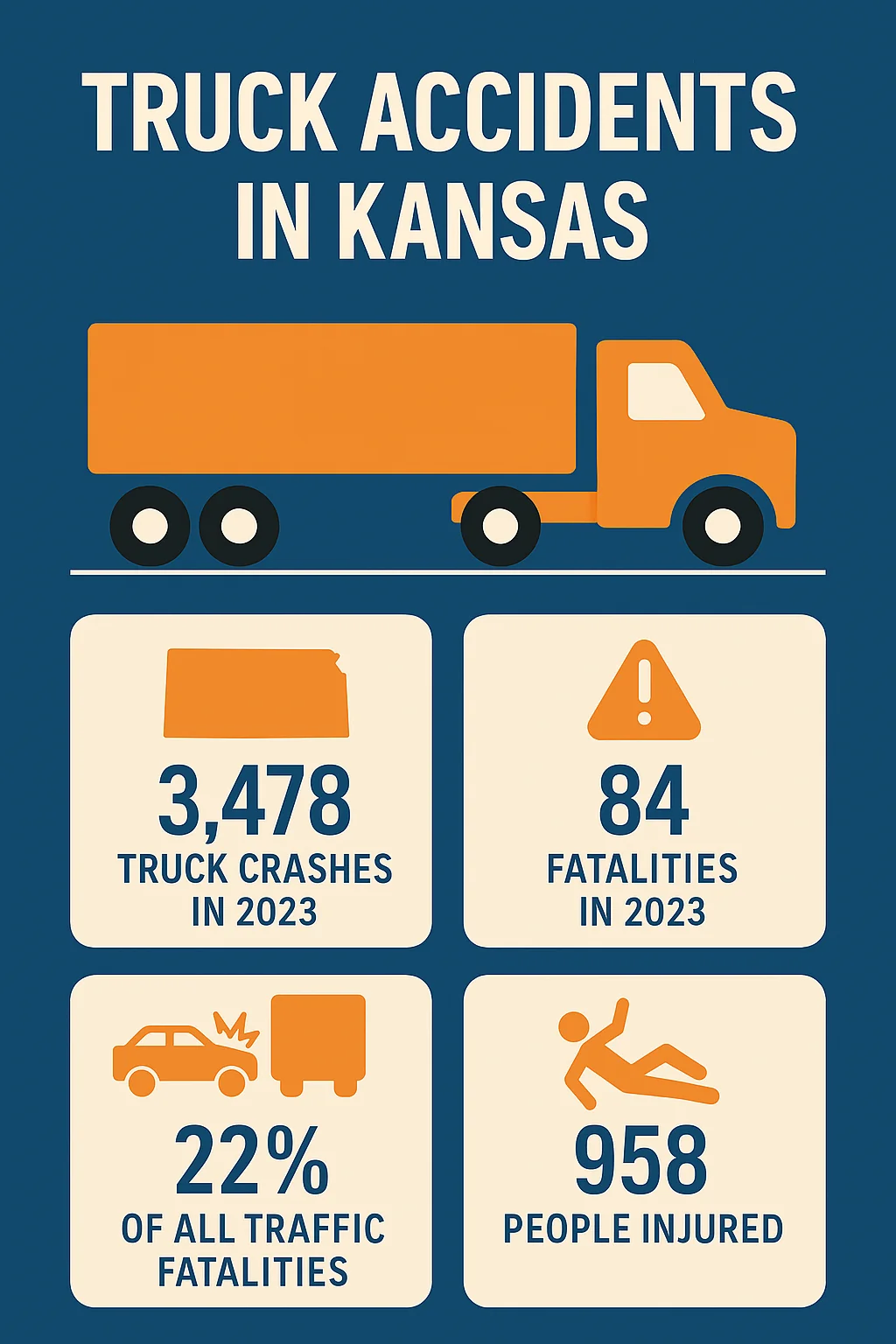
The Kansas Traffic Crash Facts 2023 report recorded 3,478 crashes in its heavy/large-truck category: 71 fatal crashes, 716 injury crashes, and 2,691 property-damage-only crashes. Those collisions resulted in 84 deaths and 958 injured people. The category accounted for 5.8% of all reported crashes and 20.1% of fatal crashes that year. These are statewide figures for 2023, not a prediction about an individual case.
If a collision causes a death, family members can ask about a Kansas wrongful death claim.
How an Attorney Can Help With a Truck Accident Claim
- Investigate the collision: identify available records, address preservation, and evaluate the driver’s conduct, vehicle condition, and cargo.
- Evaluate responsible parties and coverage: examine the roles of the driver, carrier, loaders, repair providers, and other businesses where the facts support doing so.
- Document losses and discuss insurance offers: review medical information, missed work, future needs, and any proposed settlement or release.
- Check deadlines: Kansas law generally provides a two-year limitation for personal injury and wrongful death actions under K.S.A. 60-513. When the period begins and whether an exception or another requirement applies depend on the claim. Get advice about your actual deadline promptly.
What Damages Are Available After a Truck Accident in Wichita?
If you've been injured in a truck accident in Wichita, you may be entitled to recover several types of damages, both economic and non-economic, depending on the severity of the crash and the impact it has had on your life. These damages are designed to compensate you for your losses and help restore your financial and personal well-being.
Common damages available in Wichita truck accident cases include:
- Medical Expenses: Coverage for emergency room visits, surgeries, hospital stays, physical therapy, prescription medications, and long-term medical care.
- Lost Wages: Compensation for income lost while recovering from your injuries, including time missed from work, missed promotions, or reduced hours due to physical limitations.
- Loss of Earning Capacity: If your injuries prevent you from returning to your previous job or working at all, you may be entitled to compensation for diminished future earnings.
- Pain and Suffering: This includes compensation for the physical pain, emotional distress, and psychological trauma caused by the crash and its aftermath.
- Property Damage: Reimbursement for the repair or replacement of your vehicle and any personal property damaged in the accident.
- Disfigurement or Disability: Compensation for permanent physical impairments, scarring, or loss of bodily function.
- Loss of Consortium: In some cases, spouses may recover damages for the loss of companionship, support, or affection resulting from the injuries.
Every truck accident case is unique. Available compensation depends on the evidence, applicable law, fault, and insurance coverage. We also serve injured victims in Wichita and throughout the state of Kansas in a number of different personal injury matters, such as:
If you or a loved one has been seriously injured in a Wichita truck accident, we are here for you. Call us today or connect with us online to learn more.
Discuss Your Wichita Truck Accident With the Firm
Riedmiller, Andersen & Scott represents injured people in Wichita, Sedgwick County, and throughout Kansas. For a free consultation about a semi-truck or commercial-vehicle collision, call (316) 648-1369 or contact the firm online. Discuss the records you have, the questions you need answered, and the contingency-fee and expense terms before you decide whether to hire the firm.